3 False Theology Beliefs You Didn’t Choose—But Your Trauma Built Anyway

Let’s dig a little deeper into this topic. Once you see that trauma didn’t just hurt you, but shaped how you interpret God, you start to realize something else:
Some of what you’ve been calling “faith”…is actually adaptation.
Not rebellion or lack of belief. This is straight adaptation.
Your nervous system did what it had to do to survive what you went through.
But in the process, it formed beliefs that feel true, even when they don’t align with what you intellectually believe about God.
Let’s shine a spotlight on the three most common ones.

1. “God Provides… But I Have to Make It Happen”
Ah yes, the old, "If it's meant to be, it's up to me" mindset. This is one of the most socially acceptable distortions. It even looks responsible.
Capable. Strong. Dependable.
But underneath it? It’s built from moments where provision didn’t come the way you needed it to.
Times when you had to:
Figure it out alone
Carry more than you should have
Step up when no one else did
So your system adapted:
“Don’t wait. Don’t rely. Make it happen.”
Now you live in a constant state of:
Over-functioning
Hyper-responsibility
Inability to rest
You say you trust God, but your body is telling a different story. Somewhere along the way, your body learned: If I don’t do it, it won’t get done.
What’s Actually Happening (Nervous System Level)
This is a brilliant control-based safety strategy. Your nervous system equates:
Control = Safety
Letting go? Trusting? Receiving? That doesn’t feel peaceful. It feels dangerous. So even when provision shows up… You can’t fully relax into it.
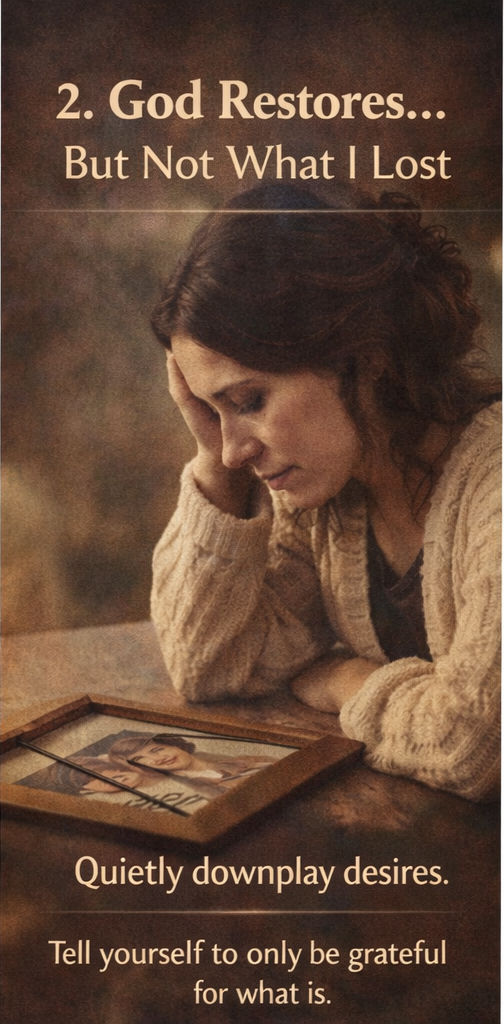
2. “God Restores… But Not What I Lost”
This one is quieter, more hidden, but it sure runs deep.
It forms after:
Significant loss
Broken relationships
Betrayal
Missed opportunities that can’t be recreated
And instead of outright rejecting restoration your system adjusts the expectation:
“God restores… just not this.”
So you:
Stop asking for certain things
Downplay desires
Tell yourself to “just be grateful for what is”
But underneath? There’s grief that was never fully processed.
And a belief forming that says:
“Some things don’t come back.”
What’s Actually Happening (Nervous System Level)
This is a protective shutdown.
Your body learned:
“Hope leads to pain.”
So instead of risking disappointment again, it reduces expectation.
This is where functional freeze often deepens:
You’re still functioning
Still showing up
But you’ve quietly disconnected from desire
Not because you don’t want more, but it just feels unsafe to have desires.

3. “Others Are Blessed… I’m Overlooked.”
This one will mess with you the most because while you can celebrate others, be genuinely happy for them, somewhere inside, there’s a quiet narrative running:
“That’s for them… not for me.”
That belief can be so painful, and it forms when you’ve experienced:
Being unseen
Being passed over
Giving more than you received
Watching others get what you’ve prayed for
So your brain does what it does best:
Pattern recognition → “This keeps happening to me.”
Projection → “So it will keep happening.”
And now you’re living in a subtle expectation of being overlooked.
Not loudly.
But consistently.
What’s Actually Happening (Nervous System Level)
This is a rejection-avoidance pattern.
Your system is trying to protect you from the pain of:
Disappointment
Comparison
Feeling “less than”
So it lowers expectations ahead of time.
“Don’t expect it. That way it won’t hurt when it doesn’t happen.”
But here’s the problem:
You’re not just avoiding disappointment. You’re also blocking the ability to fully receive.
Why These Beliefs Feel So Real
None of these beliefs came out of nowhere. They were built through repetition.
Experience after experience taught your body:
What to expect
What to prepare for
What to avoid
So now, even if your mind believes truth, your body is still responding to history.
That’s why:
You can know God is good—and still feel guarded
You can believe in provision—and still overwork
You can hear promises—and still feel like they don’t apply to you
This is not hypocrisy.
This is a nervous system that learned the wrong lesson from real pain.
You Don’t Fix This by Forcing Better Beliefs
And this right here is where most people get it wrong.
They try to:
Replace the thought
Speak more truth
Declare harder
“Have more faith.”
You can’t override a felt pattern with a forced statement because this isn’t just cognitive. It’s physiological.
What Actually Shifts This
You don’t need to argue with these beliefs; you need to out-experience them.
That means:
Creating new experiences of safety
Letting your body feel what it avoided
Releasing stored emotional weight
Gently retraining your system to receive instead of brace
This is how the belief begins to loosen.
Not because you forced it to change.
But because your body no longer needs it.
You’re Not Misaligned. You’re Protecting
Let me say this clearly:
You didn’t build these beliefs because you lack faith. You built them because you lived through things that required adaptation, and your system chose survival. It does mean that what once protected you is now limiting what’s possible for you. Not very helpful in the long run, but up til this point, remember- you've been surviving.
If You Saw Yourself in This
Then you know by now that you are not crazy. You’re not broken, my friend, you’re not the exception. You are living in a common survival pattern, a pattern that simply needs to be interrupted. No pressure, just the right process. When your nervous system finally realizes it is safe to experience something different, that is when everything shifts.


Comments